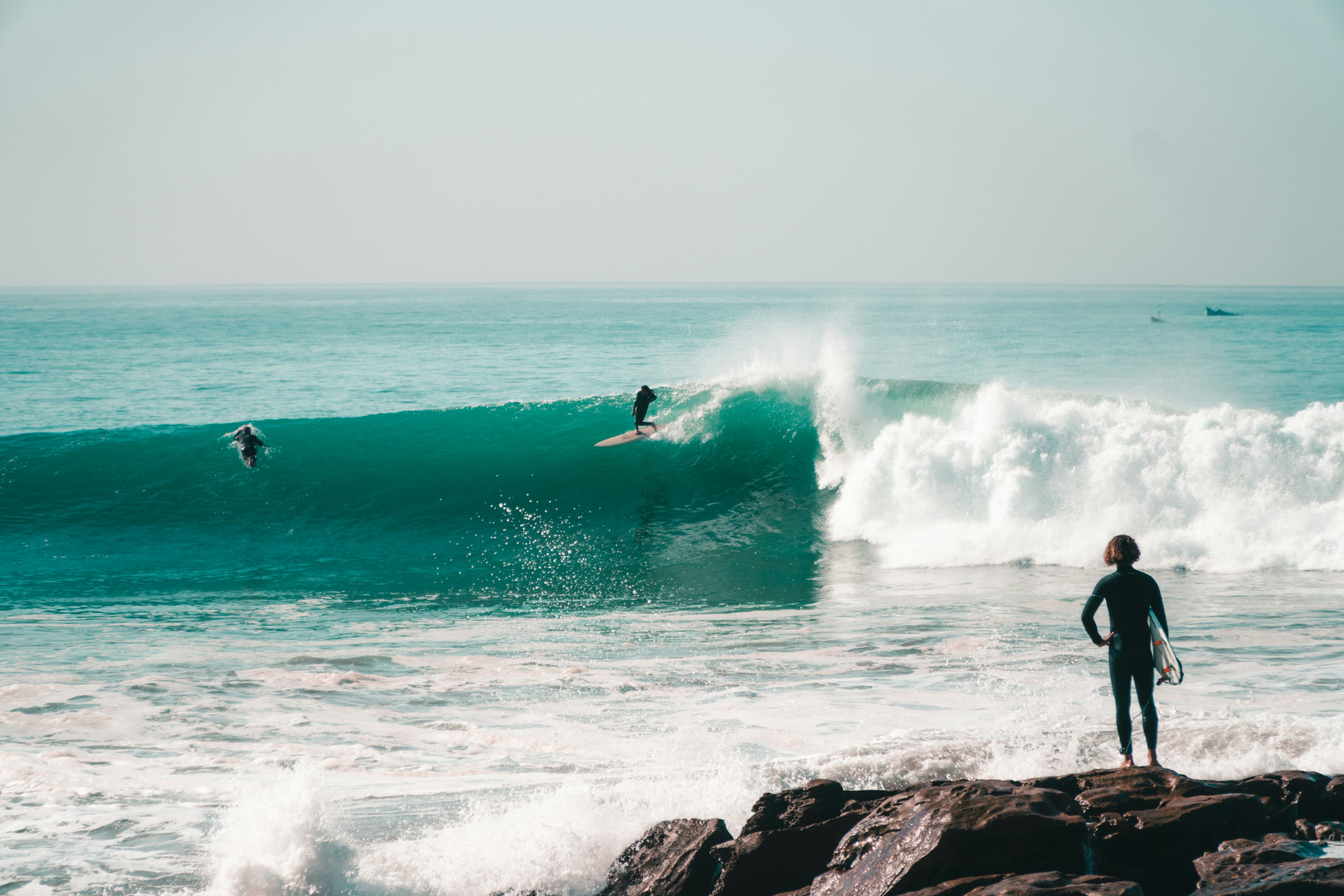
Locally the point is not called Anchor Point at all. It is Almadraba - an old Arabic term for the maze of nets once used to trap Atlantic bluefin tuna - and it was a fishing ground long before anyone thought to ride it. The English name is generally traced to ship anchors lodged in the rocks at the point. Local surfers say that on the lowest spring tides, old anchors are still visible deep in the rocks near the third section - though this is an account passed down by word of mouth rather than something documented, so treat it as local lore worth checking with your own eyes rather than a guaranteed sighting.
Until a few years ago, you could still see the ruins of an old tuna factory near the point - by most accounts standing roughly 100 metres toward the village from the tip of the rocks, in what is now the car park. Whether any trace of the wall still stands is worth confirming on the ground, as more recent accounts suggest the ruins may since have been cleared.
Travelling Australian surfers are usually credited with the first sessions here in the early 1960s, though the claim is disputed and some accounts have Europeans riding it earlier. Sixty years on it is still the wave every other right-hander on this coast is measured against.
How the wave works
Anchor Point peels off the rocky headland a short way north of the village, and on its day it does not so much break as unfold: long, mechanical lines wrapping around the point. There are three sections. The outside, at the tip, holds the biggest and heaviest water. The middle is a long workable wall. The inside softens as it comes towards the beach, and is where an improving surfer can get a feel for the place. On a big, clean swell the three link into one ride that runs most of the way back towards the village.
It starts working around 3 ft and holds size well beyond head-high, with big, clean swells pushing it into double-or-triple-overhead territory before it becomes more of a paddling contest than a rideable wave. The sweet spot most people name is 4 to 10 ft, big enough to wrap the point without turning into that paddling contest. Past 6 ft the crowd naturally spreads into three separate lineups along the point's three sections, since the ride gets long enough to pass the wave down the line. It breaks over rock, wants swell out of the north-west, and is groomed offshore by wind off the land from the east or north-east. Low to mid tide is the usual call.
The live numbers for today - score by the hour, swell, wind, tide - are on this page above; this section is only the part a forecast cannot tell you.
Not a beginner's wave
The reputation is earned. Rock underneath, a long paddle back against the current, and real power behind it when a proper swell lands. Entries and exits are timed with the lulls, and the way back in is planned around the shelf rather than improvised. That edge is a good part of why the place is legendary rather than merely popular - and it rewards anyone who treats it with respect. A confident intermediate on the right board, on a modest three-foot day, can have the session of their trip.
You do not have to paddle out to make the trip worth it. The point is one of the best places on this coast simply to sit and watch, and there is usually someone selling mint tea in the car park.
Getting there
The point is a short distance north of Taghazout village along the coast road towards Imsouane and Essaouira. Estimates on the walk vary quite a bit depending on where in the village you start - anywhere from around 10 minutes if you're already near the village's northern edge, up to 30 minutes or so from the main square - so treat any single figure with a pinch of salt and ask locally on the day. A grand taxi or moto-taxi from the village centre is a quick, cheap alternative; ask for Anchor Point or Almadraba and any driver will know it. Parking right at the point is free and roadside, though it fills up fast on good swell days.
Why it matters
Anchor Point is the reason Taghazout became a surf town at all. The camps along the coast road, the winter arrivals in Tamraght and Taghazout, the competitions - all of it follows from a handful of travellers finding a fishing point called Almadraba and realising what it did on a north-west swell.
That pull is still visible today. Anchor Point has hosted the Pro Taghazout Bay, a World Surf League Qualifying Series event, every year since 2020. The 2025 edition (QS 3,000) ran from 22 February to 1 March, with Anchor Point firing four-to-six-foot surf for nearly the whole week; Jorgann Couzinet and Francisca Veselko took the wins. The event was upgraded to QS 4,000 for 2026, co-sanctioned by WSL Europe and WSL Africa and run from 22 to 29 March, with Janire Gonzalez Etxabarri and Adur Amatriain crowned champions. For a wave that started life as a fishing ground, it's now a fixture on the global competitive surfing calendar - and on the right swell, still the best seat in Morocco to watch it happen.